
The History of Breguet: The Watchmaker Who Changed Watchmaking
Long before Rolex, Patek Philippe or Audemars Piguet existed, Abraham-Louis Breguet was already changing the way watches were made.
He developed one of the first reliable self-winding watches. He invented the tourbillon. His hands and engine-turned dials became design signatures copied across the industry. He made extraordinary timepieces for kings, queens and emperors. And in 1810, he received an order for what is considered the earliest documented watch designed specifically to be worn on the wrist.
Few individuals have influenced fine watchmaking as profoundly. The story begins in Paris in 1775.
The Beginning of Breguet
Abraham-Louis Breguet was born in Neuchâtel, in present-day Switzerland, in 1747. As a young man he continued his training in Versailles and Paris, developing a deep interest not only in watchmaking but in mathematics and physics.
In 1775, he opened his own workshop on the Île de la Cité in Paris. The timing was extraordinary. Paris was one of the intellectual and cultural centers of Europe, Breguet soon gained access to the French court, and his clientele grew to include some of the most powerful people of his era.
But his reputation wasn't built on famous customers. It was built on invention.
The Watch That Wound Itself
One of Breguet's earliest achievements tackled a problem watchmakers are still refining today: keeping a mechanical watch running without constant hand winding.
Around 1780, he developed the Perpétuelle, a watch with an oscillating weight that wound the movement as its owner moved. Breguet was not the first to experiment with self-winding mechanisms, but his was reliable enough to succeed commercially. The first Perpétuelle was sold to the Duc d'Orléans in 1780, and the watches quickly built his reputation among Europe's elite.
The idea seems ordinary today. At the time, a watch that wound itself was remarkable.
Creating the Breguet Look
Breguet cared just as much about how a watch looked. In 1786, he began using guilloché, or engine-turning, extensively on dials. The finely engraved patterns were beautiful, but they also reduced glare and helped separate the different indications on a complicated dial.
He also developed the slender hands with a hollow, off-center circle near the tip that are now known simply as Breguet hands. More than two centuries later, both remain closely associated with the brand. That is one measure of successful design: you can recognize it generations after its creator is gone.
Marie Antoinette and Watch No. 160
Among Breguet's most famous clients was Marie Antoinette, Queen of France, who owned several of his timepieces and helped introduce his work at court.
Around 1783, an unidentified admirer placed an extraordinary order for a watch intended for the Queen. The instructions were essentially to make the finest watch possible: every complication and refinement known at the time, gold wherever practical, and no meaningful limits on cost or time.
The result, Breguet No. 160, known as the Marie-Antoinette, became one of the most extraordinary watches ever made. There was one problem. Marie Antoinette never saw it. She was executed in 1793 during the French Revolution, and Breguet himself died in 1823. The watch was finally completed under his son's direction in 1827, more than four decades after it was ordered.
It included a perpetual calendar, minute repeater, thermometer, power-reserve indicator and self-winding mechanism, and for nearly a century it remained the most complicated watch known.
The Invention of the Tourbillon
Perhaps no Breguet invention is more famous than the tourbillon.
Pocket watches spent much of the day upright in a pocket, and Breguet recognized that gravity affected a watch's regulating parts differently depending on their position. His solution was ingenious: mount the escapement and balance wheel in a rotating cage, so that positional errors average out over time instead of acting from one fixed orientation.

On June 26, 1801, Abraham-Louis Breguet received a patent for the mechanism he called the tourbillon, and the first commercial examples followed several years later. Today, tourbillons are made by many of the world's finest watchmakers and have become a symbol of complicated mechanical watchmaking. It all began with Breguet.
Breguet and the First Wristwatch
For modern collectors, perhaps Breguet's most important contribution began with a commission from a queen.
Caroline Murat, Queen of Naples and younger sister of Napoleon Bonaparte, was one of Breguet's most important clients. On June 8, 1810, she ordered an unusual watch: rather than carrying it in a pocket, she wanted to wear it on her wrist.
Breguet's records document watch No. 2639, an oblong repeating watch mounted on a bracelet of hair woven with gold thread. It was commissioned in 1810 and delivered in 1812, and Breguet identifies it as the first watch designed specifically for the wrist. The original has since disappeared, but the records of its creation survive, and today's Reine de Naples collection takes its inspiration from that commission. We tell the rest of that story in our history of wristwatches.
More than 200 years later, the idea that once seemed unusual, a watch on the wrist, is simply how most of us picture a watch.
Watchmaker to the French Royal Navy
Breguet's work reached far beyond royalty. At sea, navigators needed precise time to calculate longitude, so accurate timekeeping was a matter of safety. In 1815, King Louis XVIII appointed Abraham-Louis Breguet Watchmaker to the French Royal Navy, one of the most prestigious appointments a watchmaker could receive. Breguet went on to supply marine chronometers for naval use, a heritage the modern Breguet Marine collection still references.
From Abraham-Louis Breguet to the Next Generation
Abraham-Louis Breguet died in 1823 at the age of 76. His son and longtime associate, Antoine-Louis Breguet, took over and continued his father's work. The company passed through different owners over the following generations, but the Breguet name and many of its design traditions survived. And in the 20th century, Breguet became associated with an entirely different frontier: aviation.
The Type XX Takes to the Sky
In the early 1950s, the French military was looking for robust chronograph wristwatches for its pilots, and Breguet was among the companies chosen to build watches to the government's Type 20 specification.
Breguet began developing its aviation chronograph in 1952, received approval in 1953 and won a major French Air Ministry contract in 1954, with the first military deliveries in 1955. Military watches were designated Type 20, while civilian versions became known as the Type XX, which grew into one of Breguet's most recognizable collections and shares a cockpit lineage with the Breitling Navitimer.

It is a remarkable contrast: the same watchmaker whose history includes Marie Antoinette and Napoleon's sister also built chronographs for military pilots.
Breguet Watches That Define the Brand
- Classique: perhaps the purest expression of traditional Breguet design, with engine-turned dials, slender cases and Breguet hands.
- Tradition: watches that reveal much of their mechanical architecture, inspired by Breguet's early subscription watches.
- Reine de Naples: inspired by the wristwatch commissioned by Caroline Murat in 1810.
- Marine: tied to Breguet's 1815 appointment as Watchmaker to the French Royal Navy.
- Type XX: aviation chronographs tracing their heritage to Breguet's work for the French Air Force in the 1950s.
Few luxury watch brands can draw on such different chapters of history without inventing the connection after the fact. In Breguet's case, the history actually happened.
Why Breguet Matters
Breguet's importance can't be measured by the popularity of any single modern watch. Its founder helped establish ideas that became part of watchmaking itself: automatic winding, the tourbillon, engine-turned dials, a distinctive hand design, marine chronometry and a remarkably early wristwatch.
Many collectors recognize Rolex, Cartier or Patek Philippe more readily. But anyone who follows the history of fine mechanical watches eventually arrives at Abraham-Louis Breguet. His influence is everywhere.
A Breguet, or any fine watch carrying generations of craftsmanship, deserves thoughtful protection when it travels. A quality watch roll keeps it secure and away from other watches while you are away from home. Sometimes preserving a fine watch means preserving a little piece of history.
Breguet History FAQ
When was Breguet founded?
Abraham-Louis Breguet opened his workshop in Paris in 1775, after training in Versailles and Paris.
Who was Abraham-Louis Breguet?
A Swiss-born watchmaker who built his business in Paris and became one of the most influential figures in the history of mechanical watchmaking. His innovations include the tourbillon and major advances in self-winding watches, shock protection and watch design.
Did Breguet invent the tourbillon?
Yes. Abraham-Louis Breguet was granted a patent for the tourbillon on June 26, 1801. It was designed to improve a pocket watch's accuracy by averaging out the effects of gravity in fixed vertical positions.
Did Breguet make the first wristwatch?
Breguet's archives document an 1810 commission from Caroline Murat, Queen of Naples, for what Breguet describes as the first watch designed specifically to be worn on the wrist. It was delivered in 1812.
What was the Marie-Antoinette Breguet watch?
Breguet No. 160 was an extraordinarily complicated watch commissioned around 1783 by an unidentified admirer for Marie Antoinette. Both the Queen and Breguet died before it was finished, and it was completed in 1827 under his son's direction.
What are the most famous Breguet watches today?
Major Breguet collections include the Classique, Tradition, Reine de Naples, Marine and Type XX, each drawing on a different part of the brand's heritage.
How should you protect a Breguet when traveling?
A well-made watch roll or travel case helps protect a Breguet from scratches and contact with other watches. Look for a soft interior, a secure closure and individually sized cushions, and keep valuable watches in your carry-on.
From the courts of 18th-century Paris to the tourbillon, an early wristwatch and the cockpits of French military aircraft, Breguet's history spans 250 years. Few watchmakers have contributed more ideas to the craft, and few names can claim a heritage quite like it.
Continue the series with the history of Richard Mille, or explore Series I, our handmade watch rolls.
Made for what you value.
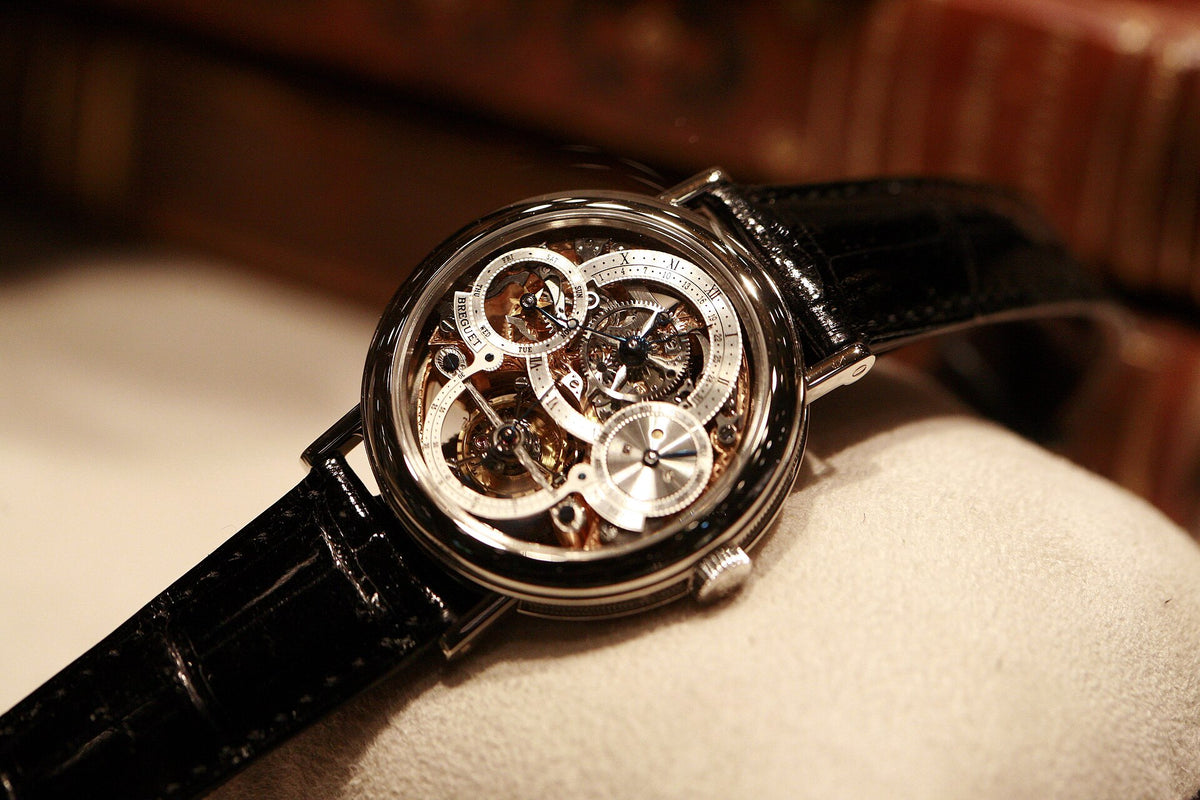
Header image: A Breguet Classique Complications, reference 3755. Photo: Rama / Wikimedia Commons / CC BY-SA 2.0 FR. Watch photographs are used for editorial purposes; Winsome is not affiliated with the brands discussed.