
The History of Breitling: From Chronographs to the Navitimer
Few watchmakers are as closely associated with aviation and the chronograph as Breitling.
For more than 140 years, the Swiss company has built watches around a simple idea: a timepiece can be more than something that tells time. It can be an instrument. That philosophy led Breitling from precision timers and early wrist chronographs to cockpit instruments, dive watches and one of the most recognizable pilot's watches ever made, the Navitimer.
Its story begins in Switzerland in 1884.
The Beginning of Breitling
In 1884, 24-year-old watchmaker Léon Breitling opened a workshop in Saint-Imier, Switzerland. From the start, he concentrated on chronographs, stopwatches and other instruments for measuring elapsed time.
That specialization proved valuable. As industry, transportation, competitive sport and eventually aviation developed, accurate timing mattered more and more. Business grew quickly, and in 1892 Léon moved the company to La Chaux-de-Fonds, one of Switzerland's great watchmaking centers.
Helping Shape the Modern Chronograph
Breitling did more than produce chronographs. It helped define how they work.
After Léon's death, his son Gaston continued the focus on precision timing. In 1915, Gaston developed one of the first wrist chronographs with a separate pusher at 2 o'clock. Until then, the chronograph had usually been operated through the winding crown, so a dedicated pusher made it far easier to use.
Breitling refined the idea in 1923 by separating the start/stop function from the reset. Then, in 1934, third-generation owner Willy Breitling patented a second pusher at 4 o'clock dedicated to resetting the timer. The layout found on countless chronographs today, a crown between two pushers, was effectively established.
From the Wrist to the Cockpit
As aviation expanded in the first half of the 20th century, pilots needed accurate instruments for navigation, fuel calculations and flight operations, and Breitling found a natural market for its expertise. By the late 1930s, its Huit Aviation department was supplying onboard chronographs to the Royal Air Force.
The company was no longer simply making watches inspired by aviation. It was making instruments used in aircraft. That relationship would eventually lead to Breitling's most famous watch, but first came another important innovation.
The Chronomat
In 1940, Breitling patented a circular slide rule that could perform a range of mathematical calculations. The watch built around it, introduced in 1942, was called the Chronomat, a contraction of chronographe mathématique.

Its rotating slide rule let the wearer work out speed, distance and other figures directly on the wrist. The Chronomat established an idea Breitling would take much further a decade later: the watch itself could be a calculating instrument.
The Navitimer
In 1952, the Aircraft Owners and Pilots Association (AOPA) approached Willy Breitling about a chronograph made specifically for pilots. Breitling adapted the Chronomat's circular slide rule for aviation, allowing pilots to calculate average speed, distance traveled, fuel consumption and rate of climb or descent.
Breitling called it the Navitimer, from navigation and timer. The first examples were made for AOPA members and carried the organization's winged insignia, and by the mid-1950s the Navitimer was offered more widely.
Its combination of chronograph, rotating slide rule and densely detailed dial made it instantly recognizable. More than 70 years later, it remains Breitling's signature watch.

From the Sky to the Sea
Breitling's reputation was built largely in the air, but in 1957 it turned its attention underwater with the Superocean. Two versions appeared at once: a time-only dive watch and the Superocean chronograph, both designed for the fast-growing worlds of professional diving and recreational underwater exploration.

The chronograph, reference 807, was especially significant. Breitling identifies it as the first dedicated dive chronograph, and its black dial with contrasting white subdials helped establish the look later known as the reverse panda dial. The Superocean remains one of Breitling's major collections, and a natural counterpart to the Rolex Submariner, which arrived just four years earlier.
Breitling Goes to Space
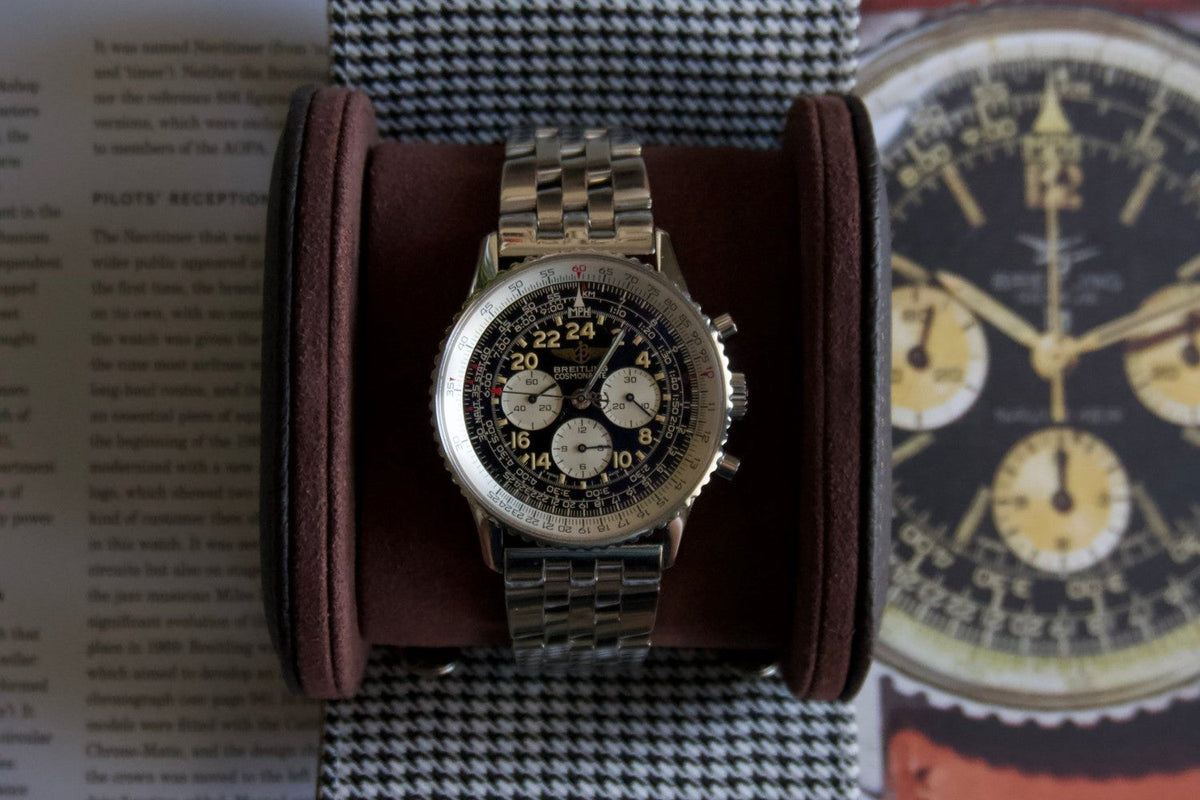
In the early 1960s, astronaut Scott Carpenter, one of NASA's original Mercury Seven, asked Breitling to adapt the Navitimer for spaceflight. One key change was a 24-hour dial, since in orbit, with sunrises and sunsets coming every 90 minutes or so, a 12-hour display could not tell day from night.
On May 24, 1962, Carpenter orbited Earth three times aboard Mercury-Atlas 7 wearing the modified Breitling. Later known as the Navitimer Cosmonaute, it became the first Swiss wristwatch worn in space.

Breitling had gone from timing instruments on the ground, to watches for pilots, to a chronograph circling the Earth.
The Premier: Function Meets Elegance
Not every Breitling was designed purely as a tool. In 1943, Willy Breitling introduced the Premier collection, which paired the company's chronograph expertise with a more refined style suited to life beyond the cockpit. The Premier showed that a chronograph could be both functional and elegant, a combination that grew more important as wristwatches shifted from essential instruments to objects people chose to wear.
Instruments for Professionals
Breitling kept developing watches for specialized uses well beyond the mechanical chronograph. In 1985, it introduced the Aerospace, a lightweight titanium watch combining analog hands with digital displays.
Then came one of its most unusual watches. The Emergency, launched in 1995, built an emergency locator transmitter into a wristwatch. In a crisis, the wearer could deploy an antenna from the case and send a distress signal to help search-and-rescue teams. Few watches have taken the idea of a wrist instrument quite so literally.
Breitling Watches That Became Icons
- Navitimer: the pilot's chronograph introduced in 1952 and Breitling's most recognizable watch.
- Chronomat: introduced in 1942 around Breitling's circular slide rule.
- Superocean: Breitling's dive collection, introduced in 1957.
- Premier: the elegant chronograph collection first introduced in 1943.
- Top Time: launched in the 1960s with a younger, more contemporary character.
- Avenger: a modern collection built for durability, with aviation-inspired design.
- Professional: technically advanced watches including the Aerospace and Emergency.
The designs vary considerably, but the same idea connects them: build a watch around what someone may actually need it to do.
Why Breitling Endures
Breitling's identity is not built on formal dress watches or precious metals. Much of its history comes from purpose: timing a race, calculating a flight, navigating a cockpit, exploring underwater, even transmitting a distress signal. That practical heritage gives its watches a character of their own, and it shares an aviation lineage with the Cartier Santos and the Breguet Type XX.
Today, a Navitimer, Superocean or Chronomat often carries meaning well beyond its original function. Like other fine mechanical watches, it may be bought to celebrate an achievement, to mark a moment, or simply because its owner appreciates the craftsmanship and history behind it. On the road, a watch roll helps protect a Breitling from scratches and from the other watches in your bag, so it can come along on the journeys it was built for.
Breitling History FAQ
When was Breitling founded?
Breitling was founded in 1884 by Léon Breitling in Saint-Imier, Switzerland. The company moved to La Chaux-de-Fonds in 1892.
Who founded Breitling?
Swiss watchmaker Léon Breitling founded the company at age 24, specializing in chronographs, precision timers and instruments for measuring elapsed time.
Why is Breitling associated with aviation?
Breitling became deeply involved with aviation in the first half of the 20th century, producing cockpit chronographs and watches for pilots. In 1952, it created the Navitimer, a wrist-worn flight instrument capable of aviation calculations.
When was the Breitling Navitimer introduced?
The Navitimer was developed in 1952 for the Aircraft Owners and Pilots Association. Its circular slide rule let pilots calculate speed, distance, fuel consumption and other flight information.
Did a Breitling watch go to space?
Yes. On May 24, 1962, astronaut Scott Carpenter wore a modified Navitimer with a 24-hour dial aboard Mercury-Atlas 7. It was the first Swiss wristwatch worn in space.
When was the Breitling Superocean introduced?
Breitling introduced the Superocean in 1957, launching both a dive watch and a dive chronograph.
What are the most famous Breitling watches?
The Navitimer, Chronomat and Superocean are the best known. Other notable collections include the Premier, Top Time, Avenger and Professional lines.
How should you protect a Breitling when traveling?
A well-made watch roll or travel case helps protect a Breitling from scratches and contact with other watches. Look for a soft interior, a secure closure and individual cushions, and keep valuable watches in your carry-on rather than checked luggage.
From Léon Breitling's small workshop in Saint-Imier to the cockpit, the ocean and even space, Breitling built its reputation by making watches meant to do something. More than a century later, that connection between precision, purpose and adventure remains at the heart of the brand.
Continue the series with the history of Breguet, or explore Series I, our handmade watch rolls.
Made for what you value.
Header image: A Breitling Navitimer Cosmonaute resting in The Espresso watch roll. Photo: Winsome. Watch photographs are used for editorial purposes; Winsome is not affiliated with the brands discussed.