
The History of Richard Mille: Reinventing the Modern Luxury Watch
Most of the great names in fine watchmaking have histories measured in centuries. Richard Mille does not. The brand introduced its first watch in 2001.
Yet in little more than two decades, Richard Mille watches have become some of the most recognizable, and exclusive, timepieces in the world. With their curved tonneau cases, exposed movements, unusual materials and unmistakably modern look, they appear very different from the traditional Swiss watches that came before them.
That was intentional. From the beginning, Richard Mille set out to approach a mechanical watch the way an engineer approaches a Formula 1 car: cut unnecessary weight, use advanced materials, expose the engineering and build every component around performance.
The Beginning of Richard Mille
Before creating the company that carries his name, Richard Mille had already spent years in the watch industry, including a long stretch with the French jeweler Mauboussin.
Along the way he became friends with Dominique Guenat, owner of the Swiss watch manufacturer Guenat SA Montres Valgine. The two shared a fascination with watches, automobiles, aviation and mechanical engineering. In 1999, they joined forces to create a new watch brand with a very different philosophy. Rather than starting from traditional watch design and gradually modernizing it, they wanted to begin with a clean sheet of paper.
The RM 001
The first watch to carry the Richard Mille name arrived in 2001: the RM 001 Tourbillon. Only 17 were made.
It established much of the design language the brand still uses: a curved tonneau case, visible spline screws, an exposed mechanical movement and a highly technical appearance. It was also priced at the very top of the market from day one, an enormous gamble for an unknown name. It worked.
Building the Watch Like a Racing Machine
Richard Mille was fascinated by Formula 1, aerospace and high-performance engineering. Instead of designing a movement and then finding a case to hold it, the brand developed the movement and case together, the way engineers develop an engine and chassis.
Traditional dials were often eliminated so the movement itself became the design. Titanium became an important structural material. Components were designed for rigidity, weight, shock resistance and ease of servicing, not just appearance. The result was an unusual combination: traditional mechanical watchmaking built with the mindset of modern engineering.
The Tonneau Case
One of the easiest ways to recognize a Richard Mille is its shape. The signature tonneau, or barrel-shaped, case curves around the wrist instead of sitting flat, and it is usually built in several sections held together by distinctive spline screws.

The shape is not merely decorative. Richard Mille says its curves, which run in several directions at once, demand exceptionally difficult machining and finishing. Depending on the material, a single case can require hundreds of operations and months of work.
It has become the Richard Mille equivalent of the octagonal Royal Oak or the rectangular Cartier Tank: a shape you recognize before you see the name on the dial.
Formula 1 Becomes Part of the Brand
Motor racing was more than inspiration. Richard Mille began putting its watches on athletes who would subject them to real forces. Formula 1 driver Felipe Massa became one of its earliest partners, and in 2007 the company introduced the RM 011 Automatic Flyback Chronograph Felipe Massa, with lightweight materials, pushers inspired by aerodynamic parts and a crown modeled on a racing wheel and tire.
Rather than asking an athlete to wear a watch at dinner or in an advertisement, Richard Mille wanted its watches worn while competing. That philosophy would soon face an even more extreme test.
Rafael Nadal and the RM 027
A tourbillon is traditionally associated with delicate, complicated watchmaking. A professional tennis match is not. That contradiction is exactly what attracted Richard Mille.
In 2010, the company developed the RM 027 Tourbillon Rafael Nadal with Nadal himself. The challenge was to build an extremely light tourbillon able to survive the acceleration, impact and sudden movements of professional tennis. Only 50 of the original RM 027 were produced, and Nadal didn't simply endorse it. He wore it while competing.
If a highly complicated mechanical watch could survive on the wrist of one of the most physical players in tennis, the engineering claim was no longer theoretical. Later Nadal watches pushed the pursuit of lightness even further.
New Materials Become Part of Luxury
Luxury watches were traditionally made in gold, platinum, steel and perhaps titanium. Richard Mille expanded that vocabulary dramatically, borrowing materials from aerospace, motorsport and advanced engineering, including Carbon TPT®, Quartz TPT®, ceramics, titanium and synthetic sapphire.
Carbon TPT®, for example, is built from extremely thin layers of carbon fiber laid at shifting angles, producing a material that is light, very strong and patterned differently on every case.
That represented a significant change in thinking. Luxury no longer had to come from a rare material. It could come from a material that is exceptionally difficult to engineer, machine and finish.
A Watch Made From Sapphire
No material illustrates that better than sapphire. Synthetic sapphire is extremely hard and highly scratch-resistant, the same qualities that make it so difficult to machine into the complex curves of a Richard Mille case.
In 2012, Richard Mille introduced the RM 056 Tourbillon Split-Seconds Chronograph Sapphire, with a case made entirely of sapphire. According to the brand, a sapphire case can take more than 1,000 hours of milling and polishing, with tolerances measured in microns. The result is a nearly transparent watch that shows the movement from almost every angle. Instead of hiding the engineering, the case nearly disappears.
Richard Mille and McLaren
The brand's fascination with Formula 1 eventually became a formal partnership with McLaren. One of its most significant results was the RM 50-03 Tourbillon Split-Seconds Chronograph McLaren F1, introduced in 2017. It combined titanium, Carbon TPT® and a graphene-enhanced material called Graph TPT™, and, strap included, weighed less than 40 grams, making it the lightest mechanical chronograph in the world at its launch.
The partnership shows something important about Richard Mille. Its relationships with Formula 1, tennis, golf and other sports are not simply chances to place a logo beside an athlete. They often serve as laboratories for new watches.
Watches Designed to Be Worn
One of the contradictions at the heart of Richard Mille is that some of its watches are extraordinarily valuable, yet they are deliberately designed for demanding use. Tourbillons are taken onto tennis courts. Chronographs are inspired by racing. A watch developed for polo player Pablo Mac Donough, the RM 53-01, had to withstand the violent shocks of polo, so it used a cable-suspended movement and a specially developed laminated sapphire crystal.
The philosophy is that these watches should not live only in safes. They are complicated luxury machines built to function in the real world.
Richard Mille Watches That Became Icons
Because Richard Mille names its watches mainly by reference number, the catalog can seem complicated at first. A few models stand out:
- RM 001 Tourbillon: the first Richard Mille, introduced in 2001 in a series of just 17 pieces.
- RM 011 Felipe Massa: the 2007 flyback chronograph that became one of the brand's most recognizable watches.
- RM 027 Rafael Nadal: the ultralight tourbillon built to withstand professional tennis.
- RM 056 Sapphire: a milestone in the use of sapphire for complete watch cases.
- RM 50-03 McLaren F1: a tourbillon split-seconds chronograph using graphene-based composite.
- RM 07-01: a key model in the women's collection and a platform for experiments with materials, color and gem setting.

Different references can look radically different, but they share the same engineering language.
A Different Definition of Luxury
Richard Mille arrived in an industry where heritage mattered enormously, and it could not claim hundreds of years of history. So it built its identity on innovation. A Richard Mille is not meant to resemble a vintage watch. Its exposed movement, curved case, unusual materials and visible fasteners all say it belongs to the modern era.
In just a few decades, the brand created a visual identity strong enough that many of its watches can be recognized from across a room. Whether you love the design or find it excessive, it is hard to mistake a Richard Mille for anything else. And in luxury, distinctiveness has value.
Protecting a Richard Mille While Traveling
Richard Mille watches are built to be worn, but that doesn't mean they should travel unprotected. A quality watch roll helps prevent scratches and contact with other watches when a valuable piece is off the wrist.
Fit matters more than usual here. Richard Mille cases vary widely in size and shape compared with traditional round watches, so look for a case with enough clearance and a soft cushion with some give, one that holds the watch securely without pressing on the case, strap or bracelet. Winsome rolls, for example, fit case diameters up to 44 mm. Whether it's a Richard Mille, a Rolex or a Patek Philippe, protection is part of traveling with something valuable.
Richard Mille History FAQ
When was Richard Mille founded?
Richard Mille and Dominique Guenat joined forces in 1999 to create the brand. The first watch carrying the Richard Mille name, the RM 001 Tourbillon, was introduced in 2001.
Who founded Richard Mille?
Richard Mille and Dominique Guenat. Guenat owned the Swiss manufacturer Guenat SA Montres Valgine, while Mille brought years of luxury watch industry experience and the vision for the brand.
What was the first Richard Mille watch?
The RM 001 Tourbillon, introduced in 2001 and limited to 17 pieces.
Why are Richard Mille watches shaped differently?
Most use the brand's signature curved tonneau case, which wraps around the wrist and gives the watch its architectural look. It is technically demanding to produce because the surfaces curve in several directions.
Does Rafael Nadal really play tennis wearing a Richard Mille?
Yes. Richard Mille developed the original RM 027 Tourbillon Rafael Nadal with Nadal and tested it in real playing conditions, and he wore it during professional matches.
What materials does Richard Mille use?
Depending on the watch, materials include titanium, Carbon TPT®, Quartz TPT®, ceramics and synthetic sapphire, as well as precious metals and gemstones. Many draw on aerospace and motorsport technology.
How should you protect a Richard Mille when traveling?
Choose a watch roll or travel case with enough clearance for the larger, curved case and a soft, properly sized cushion. Keep valuable watches in your carry-on rather than checked luggage.
Richard Mille may not have centuries of history behind its name. Instead, it created its history remarkably quickly. From the RM 001 to watches engineered for Formula 1, professional tennis and aerospace materials, it introduced a very different idea of what modern fine watchmaking could be. Tradition built much of the luxury watch industry. Richard Mille showed that innovation could build a luxury watch brand too.
Start the series from the beginning with the history of wristwatches, or explore Series I, our handmade watch rolls.
Made for what you value.
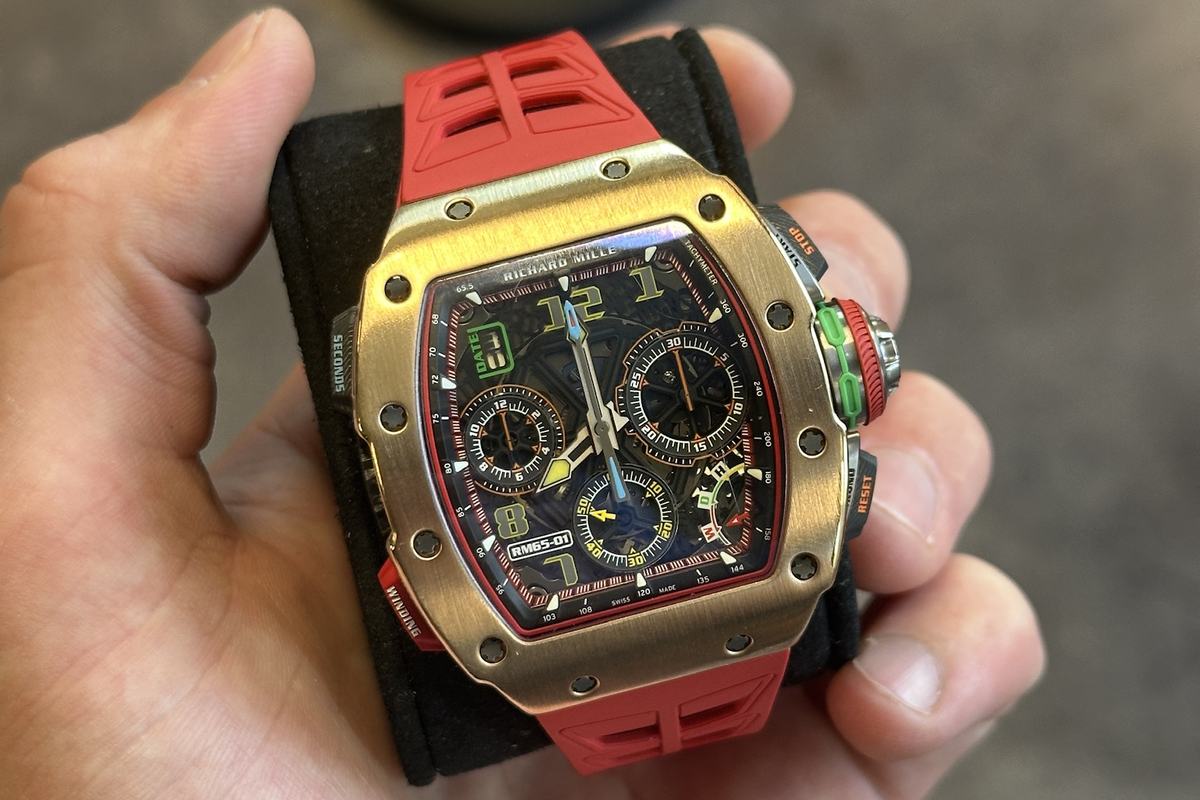
Header image: Richard Mille RM 65-01 in rose gold. Photo: Winsome. Watch photographs are used for editorial purposes; Winsome is not affiliated with the brands discussed.