
Porsche 911: The Evolution of an Icon
Some cars are replaced. Others are redesigned until very little of the original remains. The Porsche 911 has followed a different path.
For more than 60 years, Porsche has made the 911 faster, safer, more comfortable and more technologically advanced while preserving the shape, engine layout and character that defined the original. Put a 1960s 911 beside a current model and the differences are enormous. Yet there is no question they belong to the same family, right down to the black-and-white check that still appears on some of their seats.
That ability to evolve without losing its identity may be the 911's greatest achievement. For the wider story of the company, see our history of Porsche.
It Started as the 901
By the early 1960s, Porsche needed a successor to the 356: a car with more space, more comfort and substantially more performance that kept the light, responsive character of earlier Porsches. Ferdinand Alexander “Butzi” Porsche, grandson of founder Ferdinand Porsche and son of Ferry Porsche, played the central role in shaping it.
On September 12, 1963, Porsche unveiled the result at the Frankfurt International Motor Show. Its name was not 911. It was the Porsche 901, a 2+2 sports car with a low roofline, round headlights and a new rear-mounted, air-cooled flat-six producing 130 PS. Many of the traits that define a 911 today were already there.
How the 901 Became the 911
The 901 name didn't last. Peugeot objected because it held the rights in France to three-digit car model numbers with a zero in the middle. Rather than invent an entirely new number, Porsche replaced the zero with a one. The 901 became the 911, and production began in 1964.
What started as a practical fix for a naming problem became one of the most recognized model names in the world.
Establishing the Formula
The original 911 set out a formula Porsche has been refining ever since: a compact sports car with two small rear seats, a six-cylinder boxer engine behind the rear axle, responsive steering, relatively light weight and enough practicality to use every day.
Porsche soon expanded the lineup. The more powerful 911 S arrived in the 1960s, and the 911 Targa offered open-air driving with its distinctive roll bar. Displacement and power grew steadily. But Porsche resisted replacing the basic concept. Its engineers kept improving it instead, and that became the pattern for everything that followed.
Pepita: The 911's Signature Interior
The exterior shape is only half of what makes an early 911 instantly recognizable. Open the door and you will often find seat centers woven in a small black-and-white check. Porsche calls it Pepita, and most people know it as houndstooth.
Strictly speaking, Pepita is houndstooth's close cousin: a smaller, squarer two-tone check, also known as shepherd's check, rather than the larger, jagged shapes of true houndstooth. But the two belong to the same family of woven checks, and in the world of classic cars the names are used almost interchangeably.

The pattern had appeared on a few late 356s as a special request, but the 911 made it official. Pepita became an option in the original 911's equipment catalog, and from 1966 it was offered in the traditional black and white as well as black, red and white and black, brown and white, on seat centers, door panels and even the lining of the luggage compartment. The oldest 911 in the Porsche Museum, chassis number 57, built when the car was still called the 901, was restored with Pepita seat centers.
Pepita has followed the 911 through the decades since. Porsche brought it back for the 50th anniversary 911 in 2013, offered it on the seats of the 911 R in 2016, used it on the one-millionth 911 in 2017 and made it a centerpiece of the 2022 911 Sport Classic. Today it remains one of the most requested materials in Porsche's Exclusive Manufaktur program. Porsche itself calls it “a signature Porsche feature.”

The Carrera RS 2.7
Few early 911s are more celebrated than the 1973 Carrera RS 2.7. Porsche developed it so a racing version of the 911 could qualify for competition, and the formula was simple: reduce weight, increase power, improve aerodynamics.
The RS 2.7 produced 210 PS and weighed under 1,000 kilograms in lightweight form. It also introduced one of the most recognizable features in Porsche history, the “ducktail” rear spoiler, and Porsche identifies it as the first production car with both front and rear spoilers.

RS stands for Rennsport, German for “racing sport.” More than 50 years later, those two letters on the back of a 911 still mean the same thing: this is the version closest to the racetrack.

The G-Series and the First 911 Turbo
In 1973, Porsche introduced the second major generation, known as the G-Series. The silhouette stayed familiar, but the car brought substantial changes, including new impact bumpers required by evolving safety rules. The G-Series stayed in production until 1989, longer than any other 911 generation.
Then came one of the most important additions in 911 history: the Turbo. Porsche had developed turbocharging extensively in motorsport and adapted it for the road. The production 911 Turbo, known internally as the 930, arrived in 1974 with a 3.0-liter turbocharged flat-six producing 260 PS. Flared fenders, a large rear spoiler and explosive acceleration gave it a personality all its own, and Turbo became one of Porsche's most famous names.
The 964: The 911 Becomes Modern
By the late 1980s, the 911 needed more than incremental improvement. The 964, introduced for the 1989 model year, looked familiar but was substantially new underneath. Porsche says about 85 percent of the car was newly developed.
It brought power steering, ABS and much better climate control, and something especially significant: all-wheel drive. The first 964 offered to customers was the Carrera 4, using technology influenced by Porsche's 959 supercar, and an automatically extending rear spoiler improved aerodynamics without permanently altering the classic shape.
The 964 proved something Porsche would repeat many times: the 911 could become dramatically more sophisticated without looking dramatically different.
The 993: The Last Air-Cooled 911
The 993, introduced in 1994, is especially significant to collectors because it was the last 911 powered by an air-cooled engine. Its smoother bodywork modernized the classic shape while keeping unmistakable 911 proportions, and a new multi-link rear suspension improved handling and stability. The 993 Turbo also brought twin turbochargers and all-wheel drive to the Turbo line.
When production ended in 1998, more than three decades of air-cooled 911 history ended with it. That has made the 993 one of the most desirable generations among collectors.
The 996: A Controversial Reinvention
The next 911 required one of the biggest changes in the model's history. The 996, introduced in 1997, abandoned air cooling. For the first time, a production 911 used a water-cooled flat-six, driven partly by tougher emissions, noise and performance requirements.
The 996 was larger, more aerodynamic and far more modern than its predecessor, and its headlights broke from the traditional round design, one of the most debated styling changes in 911 history. For some traditionalists, it changed too much. Yet it established the architecture that carried the 911 into the modern era. The entry-level 996 produced 300 PS, while the GT2 introduced Porsche Ceramic Composite Brakes to the 911 family.
Sometimes preserving an icon requires changing it.
The 997: A Return to Familiar Design
The 997 kept the 996's technical advances while returning to traditional cues. Most noticeably, the round headlights came back, and the car felt immediately recognizable as a classic 911 again.
Technology kept advancing: Porsche Active Suspension Management, variable steering ratios, more sophisticated stability systems and PDK, Porsche's lightning-fast dual-clutch transmission. At the top of the range, the GT2 RS produced 620 PS. The 911 was becoming extraordinarily fast, and easier than ever to drive every day, a combination that has always been part of the formula.
The 991: Bigger, Faster and More Sophisticated
The 991, introduced in 2011, was another substantial engineering step: a longer wheelbase, far more aluminum in the body, a more refined cabin and increasingly sophisticated electronic chassis systems. The familiar silhouette remained.
The biggest change came midway through the generation, when Porsche moved the Carrera range, with limited exceptions, from naturally aspirated to turbocharged engines. Once again, some enthusiasts worried that part of the 911's personality was disappearing, and once again Porsche used the change to raise performance while protecting the car's character. The 991 range eventually spanned everything from everyday Carreras to the 700 PS GT2 RS. Every one of them was still a 911.
The 992: The 911 Enters a New Era
The eighth generation, the 992, arrived in 2019, wider, faster and more technologically sophisticated than any standard 911 before it. Digital displays flanked the traditional central tachometer, driver-assistance systems advanced, and turbocharged engines delivered performance once reserved for supercars. Viewed in profile, though, its relationship to the 1963 car is still obvious.
The 992 also looked back. The 2022 911 Sport Classic, limited to 1,250 cars worldwide, paired a ducktail spoiler that recalls the Carrera RS 2.7 with black-and-white Pepita on its seat centers, a direct nod to the 911s of the 1960s.

The First Hybrid 911
In 2024, Porsche introduced an extensively updated 992, often called the 992.2, and with it the 911 Carrera GTS T-Hybrid, the first road-going 911 with a performance hybrid system. Rather than designing it around electric-only driving or fuel economy, Porsche built it for performance: a new 3.6-liter flat-six works with an electrically assisted turbocharger, an electric motor and a compact high-voltage battery to sharpen throttle response and acceleration. According to Porsche, the Carrera GTS reaches 60 mph in 2.9 seconds.
It is perhaps the clearest example yet of the 911 philosophy: new technology is welcome, but it must serve the driving experience.
Eight Generations, One Idea
- Original 911: 1963–1973
- G-Series: 1973–1989
- 964: 1989–1994
- 993: 1994–1998
- 996: 1998–2005
- 997: 2004–2012
- 991: 2011–2019
- 992: 2019–present
The cars have changed enormously. The original made 130 PS, while modern 911s reach highway speeds in times once associated with race cars. There are Carrera, Targa, Turbo, GT3 and RS versions; rear- and all-wheel drive; manual and PDK; naturally aspirated, turbocharged and now hybrid engines. Yet through eight generations the basic idea has survived: a flat-six behind the driver, a compact 2+2 body and a shape that always looks like a 911.
Why the 911 Became an Icon
Plenty of cars are faster. Some are rarer, and others are more expensive. But very few have stayed relevant for more than six decades. The 911 became an icon because Porsche never treated the original as something frozen in time. Safety, performance, technology, comfort and materials all advanced, and the car grew larger and far more sophisticated. Yet Porsche remained remarkably disciplined about protecting what makes a 911 feel like a 911.
That is why an early Carrera RS, an air-cooled 993, a modern GT3 and a current Carrera GTS can be dramatically different cars that still feel connected. It is evolution rather than replacement, and perhaps that is the secret to creating something timeless.
A Pattern Worth Carrying
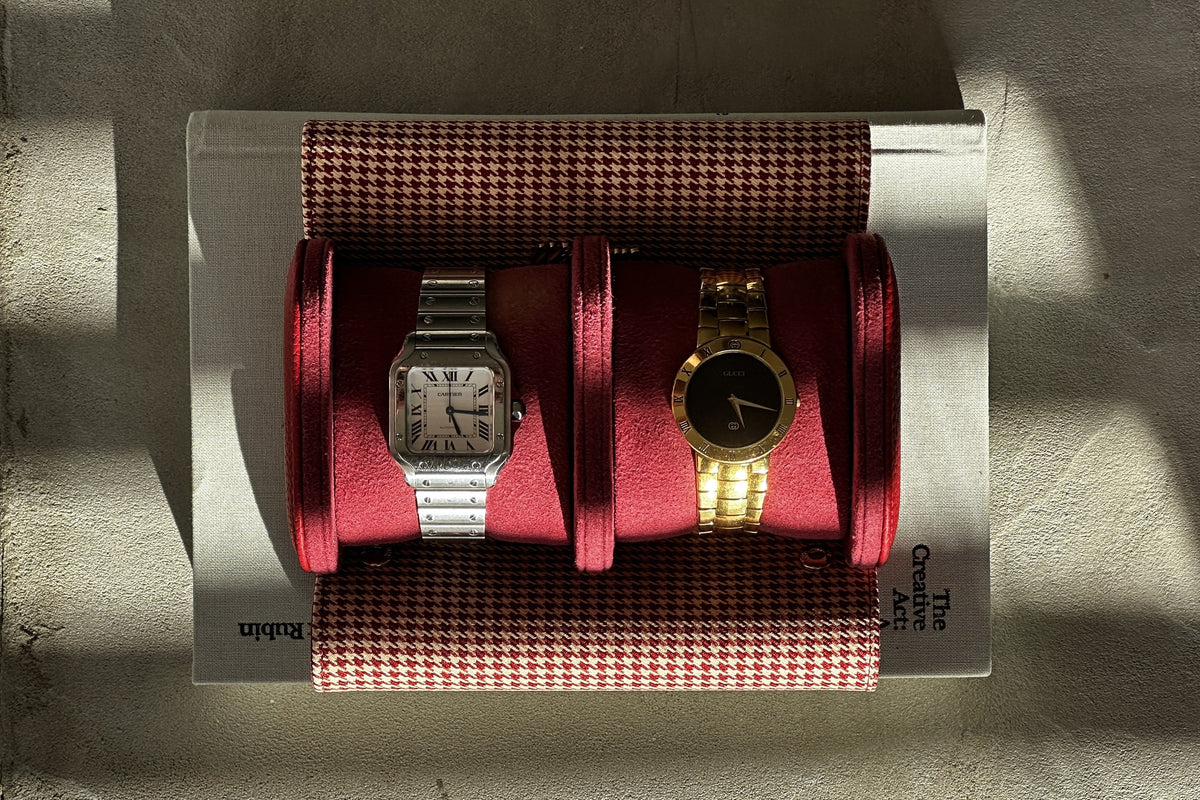
We have always been drawn to the same idea the 911 represents: things made with enough care, and enough character, that they only get better with time. The black-and-white check inside an early 911 is part of that story for us, and it is why every watch roll in Series I is wrapped in our signature houndstooth.
The Espresso comes in the classic black and white of those original 1960s interiors, while The Cabernet and The Bleuet carry the pattern in crimson and cream and in cornflower blue. Each case is hand cut and hand sewn by skilled artisans, with a suede pillow for every watch. To learn more about the pattern, read Houndstooth, Pepita and Dogstooth: The Story of a Timeless Pattern. Winsome is not affiliated with Porsche. We just appreciate a design that, like the 911, refuses to go out of style.
Porsche 911 FAQ
When was the Porsche 911 introduced?
Porsche unveiled the car, originally called the 901, at the Frankfurt International Motor Show on September 12, 1963. Customer production began in 1964.
Why was the Porsche 901 renamed the 911?
Peugeot objected to Porsche's use of a three-digit model number with a zero in the middle, so Porsche replaced the zero with a one.
Who designed the original Porsche 911?
Ferdinand Alexander “Butzi” Porsche, Ferry Porsche's son, played the central role in shaping the original car.
Did the original Porsche 911 have houndstooth seats?
Yes, as an option. Porsche offered Pepita, a small black-and-white check closely related to houndstooth, on the original 911. From 1966 it was available in black and white, black, red and white, and black, brown and white.
What does Carrera mean on a Porsche 911?
Carrera means “race” in Spanish. Porsche adopted the name after its success in the Carrera Panamericana road race and later used it on important models, including the Carrera RS 2.7.
What does RS mean on a Porsche 911?
RS stands for Rennsport, German for “racing sport.” Porsche uses it for its most performance-focused, motorsport-derived 911s.
What was the last air-cooled Porsche 911?
The 993, produced from 1994 to 1998. The 996 generation switched to water-cooled flat-six engines.
When was the first Porsche 911 Turbo introduced?
Porsche introduced the production 911 Turbo, known internally as the 930, in 1974. Its turbocharged 3.0-liter flat-six produced 260 PS.
Is there a hybrid Porsche 911?
Yes. The updated 992 Carrera GTS, introduced in 2024, was the first road-going 911 with a performance hybrid system, which Porsche calls T-Hybrid.
For more than 60 years, Porsche has changed almost everything about the 911, except the things that matter most.
Explore Series I, our handmade houndstooth watch rolls.
Made for what you value.
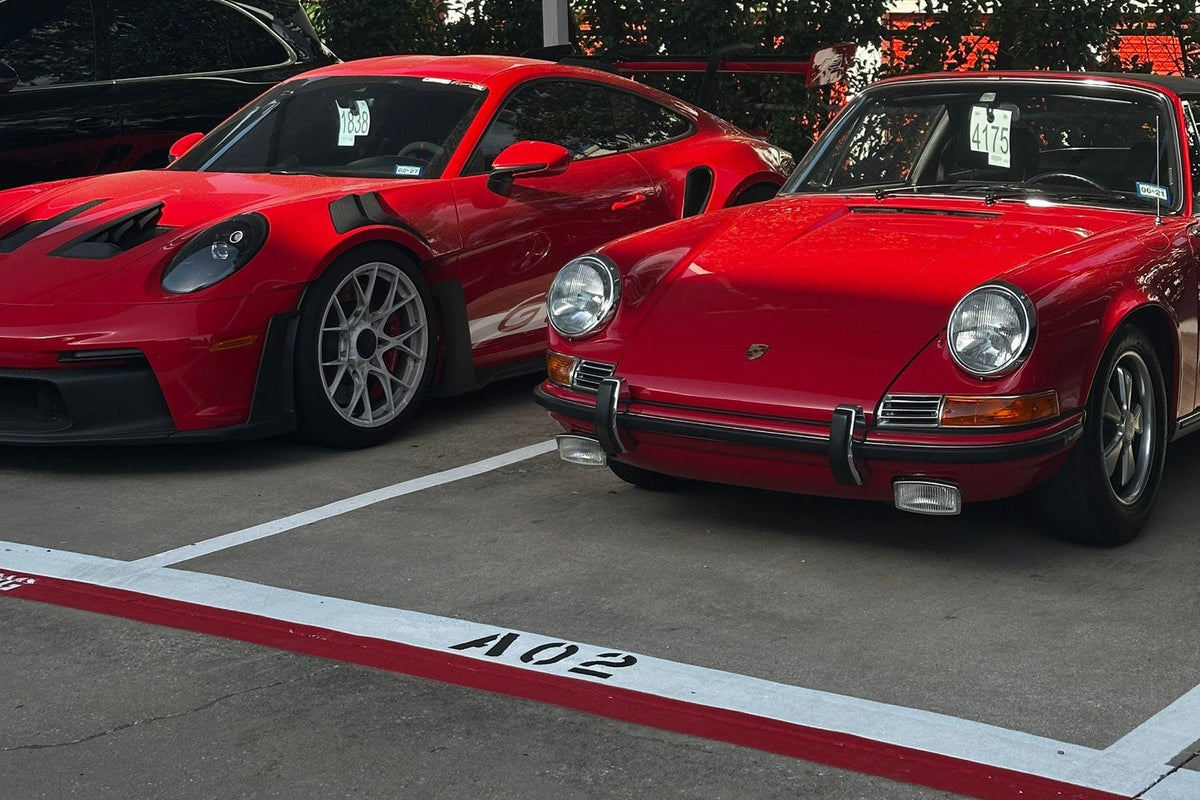
Header image: A current 911 GT3 RS parked beside an early 911. Photo: Winsome. Photographs are used for editorial purposes; Winsome is not affiliated with Porsche.